The Veria Signal - September 16, 2026
China’s anti-dumping tariffs on Japanese semiconductor materials and Huawei’s LogicFolding chip highlight escalating tech tensions, while the EU’s public procurement rules target China’s non-reciprocal trade practices. Chinese open-weight AI models like Kimi K3 are gaining global traction, reshaping AI competition.
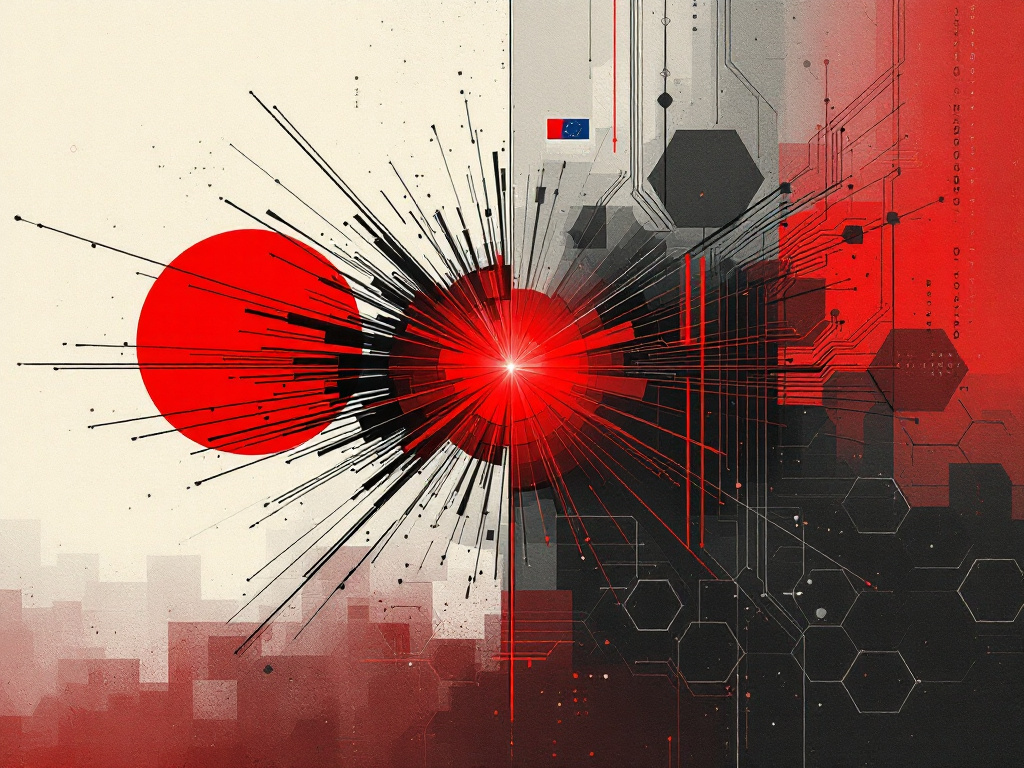


This week, the tech and trade war between China and the West took another sharp turn, with semiconductor supply chains at the epicenter. China’s anti-dumping measures on Japanese dichlorosilane (DCS), a critical material for chip manufacturing, sent shockwaves through the industry, effectively doubling costs for Japanese suppliers overnight. Meanwhile, Huawei’s unveiling of its LogicFolding chip in a new tri-fold phone underscored China’s relentless push for semiconductor self-sufficiency despite U.S. export controls. The EU’s planned public procurement rules to exclude non-reciprocal third-country firms—primarily China—signal a broader shift toward strategic autonomy, while global AI competition heats up with Chinese open-weight models like Kimi K3 gaining traction worldwide.
China’s anti-dumping tariffs on Japanese semiconductor materials escalate trade tensions
China’s Ministry of Commerce imposed provisional anti-dumping deposits of up to 99.2% on Japanese dichlorosilane (DCS), a key material for thin-film deposition in semiconductor manufacturing. The measures, effective September 8, target major Japanese firms like Shin-Etsu Chemical and Tokuyama, effectively wiping out their price advantage in the Chinese market. This move follows Beijing’s broader pattern of economic pressure on Japan, including tightened export controls on dual-use items, rare earths, and critical metals earlier this year. Japan’s government has strongly protested, calling the measures a violation of international principles, but China’s stance remains firm, framing the action as a response to Japan’s perceived alignment with U.S. tech restrictions. Sources: World Journal (September 8, 2026), TaiSounds (September 8, 2026), Sohu (September 8, 2026), NHK WORLD-JAPAN News (September 9, 2026)
What it means for you: These tariffs will force semiconductor manufacturers to accelerate domestic substitution, turning Chinese alternatives from an optional choice into a necessity. For European firms reliant on Japanese materials, supply chain diversification is now urgent. However, given the single-source nature of some reporting, verify the measures’ scope and duration before making long-term procurement adjustments.
Huawei’s LogicFolding chip signals China’s semiconductor resilience
Huawei unveiled its first mass-produced LogicFolding chip in its new tri-fold phone, a breakthrough that highlights China’s progress in advanced chip design despite U.S. export restrictions. The chip, based on Huawei’s proprietary Tau Scaling Law, represents a potential reset in China’s computing capabilities, bypassing Western tech barriers. Meanwhile, Chinese AI chipmaker Enflame surged 179% in its Shanghai debut, positioning itself as a Nvidia challenger, while Cambricon achieved day-zero adaptation for DeepSeek’s V4.1 Flash model, showcasing China’s growing semiconductor ecosystem. Sources: Caixin Global (September 8, 2026), South China Morning Post (September 8, 2026), South China Morning Post (September 11, 2026), Mydrivers (September 10, 2026)
What it means for you: Huawei’s advancements underscore the risks of underestimating China’s semiconductor capabilities. For investors, Chinese AI chipmakers like Enflame and Cambricon present high-growth opportunities, but geopolitical risks remain. European firms should monitor China’s domestic chip ecosystem for potential partnerships or competitive threats.
EU’s public procurement rules target China’s non-reciprocal trade practices
The European Commission is preparing to revise public procurement rules to allow member states to legally exclude companies from third countries—primarily China—that do not open their own public procurement markets. The draft, expected to be published September 9, aims to reduce the EU’s dependence on China amid a trade deficit of about €360 billion in 2025. While the rules set no mandatory quotas, they provide a legal basis for favoring European firms, particularly in sectors like wind turbines and critical minerals. Source: Apollo News (September 8, 2026)
What it means for you: The EU’s move signals a hardening stance on trade reciprocity, directly impacting Chinese firms bidding for European public contracts. For corporates, this may accelerate localization efforts in Europe. However, the rules’ implementation could face legal challenges, so monitor developments closely.
Chinese open-weight AI models gain global traction
Chinese AI models are increasingly becoming the foundation of global AI development, with Moonshot AI’s Kimi K3—boasting 2.8 trillion parameters—topping global coding benchmarks and Hugging Face trends. Cursor’s Composer 2 and Thinking Machines’ Inkling model have adopted Kimi K2.5 and DeepSeek-V3’s MoE architecture, respectively, while Siemens, Renault, and Orange announced “China-U.S.-Europe hybrid model” strategies. The appeal lies in low costs, open licenses like MIT and Apache 2.0, and multilingual support, contrasting with U.S. firms’ restrictive policies. Sources: The Paper (September 9, 2026), Sina Mobile (September 11, 2026), OpenRouter (September 8, 2026)
What it means for you: Chinese open-weight models are reshaping global AI competition, offering cost-effective, locally deployable alternatives to U.S. offerings. For European firms, this presents opportunities for collaboration but also risks of dependency on Chinese AI infrastructure. Monitor compliance with China’s dual-use export control regulations, particularly around model weights and overseas deployment.
Veria is built by a France-based analyst monitoring technology and geopolitics, with a special focus on the China-Europe interface, combining primary-source OSINT with human review before anything gets published. Spotted something we missed, or have a lead? Get in touch.
Sources
- World Journal - China Imposes Anti-Dumping Deposits on Japanese Semiconductor Material (September 8)
- TaiSounds - Japan Protests China’s Anti-Dumping Measures on DCS (September 8)
- Sohu - China’s Anti-Dumping Measures Push Domestic Semiconductor Substitution (September 8)
- NHK WORLD-JAPAN News - China’s Anti-Dumping Measures on Japanese DCS (September 9)
- Caixin Global - Huawei Unveils LogicFolding Chip (September 8)
- South China Morning Post - Huawei’s Tri-Fold Phone with Kirin Chip (September 7)
- Mydrivers - Cambricon Adapts DeepSeek V4.1 Flash Model (September 10)
- Apollo News - EU Plans Public Procurement Rules to Exclude China (September 8)
- The Paper - Chinese AI Models as Global Foundation (September 9)
- Sina Mobile - Kimi K3 Model and IPO Plans (September 11)